Weird wealth sounds almost contradictory. Wealth is usually associated with familiar paths: a high-paying career, real estate, investing, entrepreneurship, or inheriting money. But the modern economy has created plenty of less conventional routes to financial success.
Some people make fortunes selling products that seem ridiculous at first. Others turn obscure hobbies, internet audiences, digital assets, collectibles, niche software, or strange business ideas into serious sources of income.
That is the idea behind weird wealth: money created through unusual, unexpected, unconventional, or surprisingly valuable opportunities.
What looks strange to one person can be an extremely profitable niche to another.
The rise of social media, creator platforms, online marketplaces, artificial intelligence, digital products, subscription businesses, and global e-commerce has made it easier than ever to turn a small or unusual idea into a business.
In this guide, we explore what weird wealth means, how unconventional fortunes are created, examples of unusual wealth-building models, why these opportunities work, and what entrepreneurs can learn from them.
What Is Weird Wealth?
Weird wealth refers to financial success generated through unusual, unconventional, unexpected, or niche sources.
It does not necessarily mean that the person became rich through something literally bizarre. Instead, the phrase describes wealth that comes from a path most people would not immediately consider a traditional route to financial success.
For example, someone might build a business around:
- A highly specialized hobby
- A strange but useful product
- Digital collectibles
- Niche websites
- Online communities
- A subscription service for a tiny market
- Viral internet content
- Domain names
- Digital templates
- Unusual collectibles
- Specialized consulting
- Micro-SaaS products
- Licensing intellectual property
The common thread is simple: the opportunity exists because the market is overlooked.
Weird Wealth Is Often Hidden in Small Niches
A niche does not need millions of customers to produce meaningful revenue.
Imagine a business selling a $100 product to 10,000 customers. That is $1 million in revenue.
Now imagine a specialized software product charging $50 per month to 2,000 customers. That produces $100,000 in monthly recurring revenue before expenses.
The market may appear tiny compared with a global consumer brand, but the economics can still be powerful.
This is one reason unconventional wealth creation has become increasingly interesting to entrepreneurs.
Why Does Weird Wealth Exist?
Markets are not always rational in the way people expect.
A product that seems worthless to one person can be extremely valuable to another because value depends on scarcity, demand, convenience, emotion, identity, or utility.
Consider collectibles.
A mass-produced object might cost only a few dollars when originally sold. Years later, limited supply and collector demand can make certain versions worth hundreds or thousands of dollars.
The same principle appears across modern businesses.
1. People Pay for Convenience
Consumers routinely spend money to save time.
That creates opportunities for businesses that simplify annoying tasks, automate repetitive work, deliver products faster, or remove complexity.
2. People Pay for Identity
Luxury products, collectibles, fashion, fandom merchandise, and communities often sell more than functionality.
They sell belonging.
3. Scarcity Creates Value
Limited-edition products, rare collectibles, exclusive memberships, and scarce digital assets can command premium prices when enough people want them.
4. The Internet Creates Global Niches
A strange product may have too few customers in one city to support a traditional store.
Online, however, the potential customer base can span dozens of countries.
That changes the economics completely.
Weird Wealth Examples: How Unusual Ideas Become Valuable
There is no single formula for unconventional wealth. Some examples are based on products, others on technology, intellectual property, audiences, or specialized knowledge.
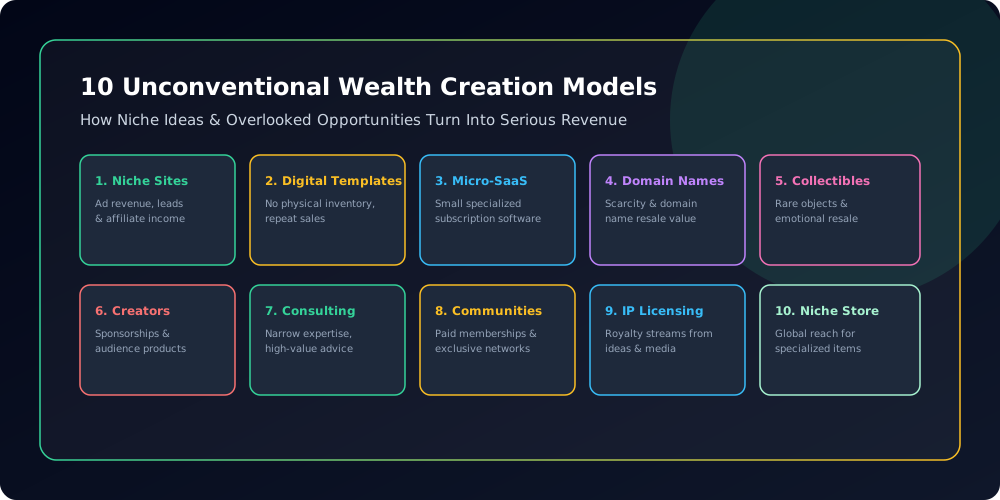
Here are some of the most interesting categories.
| Wealth Model | Why It Looks Unusual | How It Can Create Value |
|---|---|---|
| Niche websites | Tiny audience | Advertising, leads, affiliates |
| Digital templates | No physical product | Repeated digital sales |
| Micro-SaaS | Small software product | Recurring subscriptions |
| Domain investing | Selling web addresses | Scarcity and demand |
| Collectibles | Objects with emotional value | Appreciation and resale |
| Creator businesses | Personal audience | Sponsorships and products |
| Specialized consulting | Narrow expertise | High-value services |
| Online communities | People pay to belong | Membership revenue |
| Licensing | Ideas earn repeatedly | Royalties |
| Niche e-commerce | Small product category | Global customer reach |
The important lesson is that weird does not mean unprofitable.
Sometimes the strangest-looking business is simply a business serving a market that traditional companies ignored.
Weird Wealth From the Internet
The internet may be one of the biggest engines of unconventional wealth.
Before the web became mainstream, building a business usually required physical infrastructure, employees, inventory, distribution, or access to a local customer base.
Today, one person can potentially create a digital product, reach customers globally, and automate significant parts of the sales process.
That has produced several new wealth models.
Content Creators
Creators can monetize audiences through:
- Advertising
- Sponsorships
- Affiliate marketing
- Memberships
- Merchandise
- Courses
- Digital products
- Consulting
- Brand partnerships
The unusual part is that the creator's audience itself becomes an economic asset.
Digital Products
A person can create a template, guide, spreadsheet, design asset, course, prompt library, or software tool once and sell it repeatedly.
Unlike physical inventory, digital products can often be reproduced at extremely low marginal cost.
Niche Software
A developer does not necessarily need to build the next major social network.
A small piece of software solving one painful business problem can be enough to create a sustainable company.
This is particularly interesting in areas such as:
- Marketing
- Accounting
- Human resources
- Scheduling
- Productivity
- Data analysis
- E-commerce
- Customer support
- Sales automation
The smaller the problem, the easier it can sometimes be to become the obvious solution for a particular customer group.
Weird Wealth Through Collectibles
Collectibles have created some of the most surprising examples of unconventional value.
People collect everything from trading cards and watches to sneakers, toys, coins, comic books, memorabilia, and limited-edition products.
Why would someone pay thousands of dollars for something that originally cost $20?
Because the price of a collectible is determined by the interaction between rarity and demand.
A collectible can become more valuable when:
- Production was limited
- Few examples survived
- The item has historical importance
- A famous person was associated with it
- The item becomes culturally significant
- A community develops around collecting it
However, collecting should not automatically be treated as an investment strategy.
Prices can fall dramatically when interest disappears.
Weird Wealth and Unusual Businesses
Some businesses sound almost too strange to work.
Yet unusual business ideas can succeed when they solve a real problem or create a strong emotional response.
Examples include businesses built around:
- Personalized gifts
- Pet products
- Specialty foods
- Unusual subscription boxes
- Event experiences
- Hobby equipment
- Specialized clothing
- Memorabilia
- Digital communities
- Personalized services
The key is not how strange the product sounds.
The real question is:
Will enough people pay for it?
That is the question every entrepreneur should ask before investing significant money.
How People Find Unconventional Wealth Opportunities
Finding unusual opportunities is less about having a bizarre idea and more about noticing things other people overlook.
Look for Annoying Problems
People often pay surprisingly well to eliminate frustrating tasks.
Ask:
- What do people complain about repeatedly?
- What takes too long?
- What is unnecessarily complicated?
- What do businesses still do manually?
- What information is difficult to find?
Pain points often contain business opportunities.
Look for Obsessive Communities
Large markets are not the only valuable markets.
A small community with strong purchasing intent can be more attractive than a huge audience with little willingness to spend.
Examples include:
- Hobbyists
- Collectors
- Professionals
- Sports communities
- Gamers
- Pet owners
- Creators
- Small-business owners
People who care deeply about something can become highly valuable customers.
Follow Changes in Technology
New technology creates new markets.
Artificial intelligence is a good example.
Every major technological shift creates businesses around:
- Software
- Education
- Consulting
- Integration
- Automation
- Data
- Infrastructure
- Specialized services
The first businesses to recognize a new demand often have an advantage.
Weird Wealth Through Intellectual Property
Intellectual property can become an unusual but powerful wealth-building asset.
A person can potentially monetize:
- Software
- Designs
- Books
- Music
- Photography
- Trademarks
- Characters
- Inventions
- Educational materials
- Licensing rights
The interesting part is that the creator does not always need to sell the underlying asset directly.
Licensing allows another company to use intellectual property in exchange for royalties or other compensation.
This can transform one creative asset into multiple revenue opportunities.
The Role of Attention in Modern Wealth
Attention has become an economic resource.
A person with a large and trusted audience can potentially monetize that attention through several channels.
For example, a creator with a specialized audience might earn money from:
- Sponsorships
- Affiliate commissions
- Digital products
- Consulting
- Paid communities
- Brand partnerships
- Merchandise
This is why social media has changed the traditional relationship between audience and business.
You no longer necessarily need a huge company to reach millions of people.
Sometimes the audience comes first, and the business is built around it later.
Is Weird Wealth Actually Sustainable?
This is where the topic becomes more interesting.
A strange business idea can become profitable quickly, but profitability and long-term wealth are not the same thing.
A sustainable business generally needs:
- Consistent customer demand
- Healthy margins
- Repeat purchases or recurring revenue
- A defensible advantage
- Efficient operations
- Customer trust
- Adaptability
Going viral is not the same as building wealth.
A product may receive millions of views and generate very little profit.
Another product may have only a few thousand customers but produce dependable recurring revenue for years.
Weird Wealth vs. Viral Money
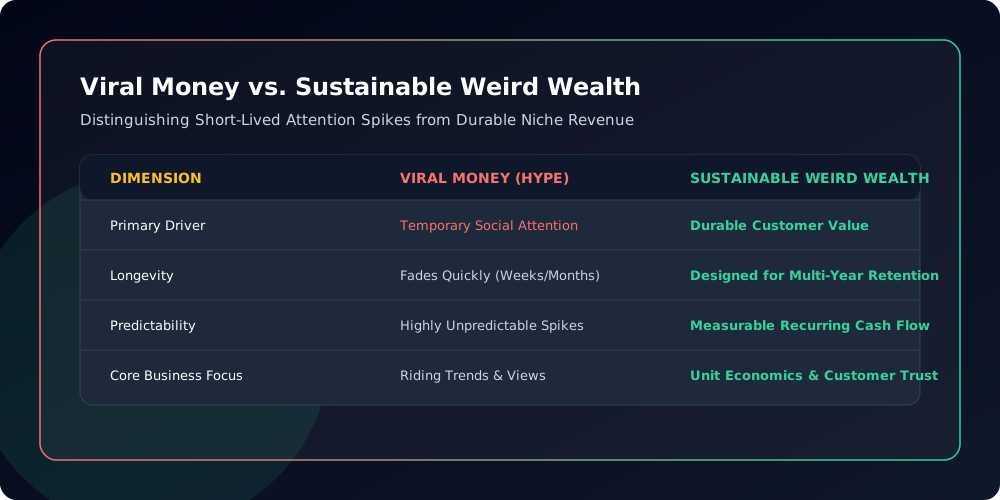
| Viral Money | Sustainable Wealth |
|---|---|
| Driven by attention | Driven by durable value |
| Can disappear quickly | Designed to last |
| Often unpredictable | More measurable |
| Dependent on trends | Based on customer demand |
| May have weak margins | Usually focused on economics |
The smartest unconventional businesses often combine both.
They use attention to acquire customers but build a real product or service underneath it.
Common Mistakes When Chasing Unusual Wealth
The idea of getting rich from something unusual can be exciting, but it can also encourage poor financial decisions.
Mistake 1: Confusing Weird With Valuable
Being unusual is not a competitive advantage by itself.
Customers still need a reason to buy.
Mistake 2: Copying a Viral Success
By the time an unusual business becomes famous, hundreds of people may already be copying it.
Instead of copying the surface-level idea, understand why it worked.
Mistake 3: Ignoring Unit Economics
Revenue is not profit.
If a product generates $100,000 in sales but costs $90,000 to produce and market, the business is very different from one generating the same revenue with much higher margins.
Mistake 4: Betting Everything on a Trend
Trends can create opportunities, but they can also disappear quickly.
A strong business should ideally survive after the initial excitement fades.
Mistake 5: Ignoring Regulation and Taxes
Unusual business models can still involve ordinary legal, tax, licensing, advertising, and consumer-protection requirements.
Before investing heavily, understand the rules applicable to the business.
How to Build Your Own Weird Wealth Strategy
You do not need a bizarre idea to participate in unconventional wealth creation.
Start with something you understand.
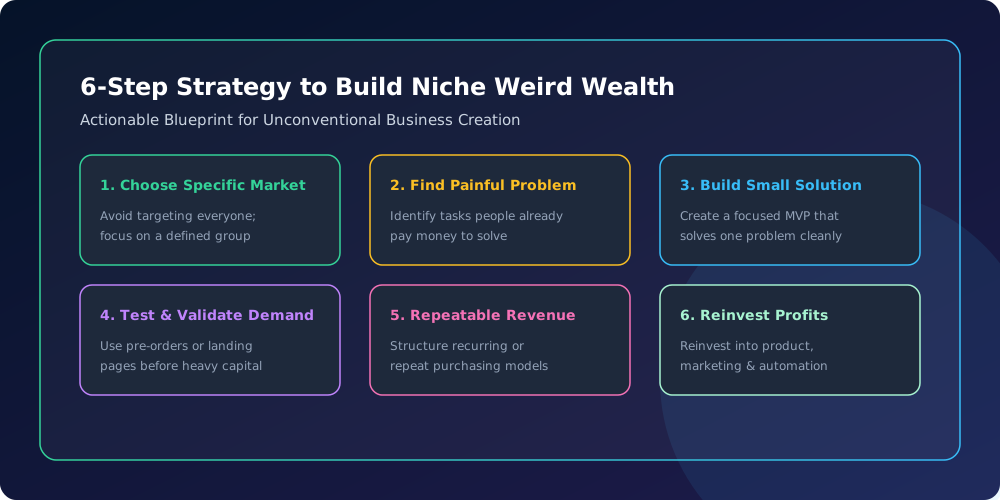
Step 1: Choose a Specific Market
Avoid starting with "everyone."
Choose a group of people with a recognizable problem.
Step 2: Find a Painful Problem
Look for something people already spend money trying to solve.
Step 3: Build a Small Solution
Your first product does not need to be perfect.
It needs to solve a real problem well enough that someone is willing to pay.
Step 4: Test Demand
Before spending heavily, validate the idea.
You can test demand through:
- Pre-orders
- Landing pages
- Small advertising campaigns
- Customer interviews
- Marketplace listings
- Social media content
Step 5: Create a Repeatable Revenue Model
Whenever possible, consider whether customers could buy repeatedly or subscribe.
Recurring revenue can make a small business much more predictable.
Step 6: Reinvest the Profits
Instead of immediately increasing personal spending, reinvest some profits into:
- Product development
- Marketing
- Customer acquisition
- Automation
- Talent
- Technology
This is where an unusual side project can potentially develop into a serious business.
Weird Wealth: What the Trend Says About the Future
The concept is likely to become even more relevant as technology reduces the cost of starting small businesses.
Artificial intelligence, no-code tools, global payment systems, creator platforms, marketplaces, and remote work have lowered many of the traditional barriers to entrepreneurship.
A person can now operate a highly specialized business from a laptop and sell to customers thousands of miles away.
That creates an interesting shift:
The future of wealth may not always come from building the biggest company. It may come from becoming exceptionally valuable to a specific group of people.
A tiny market with strong demand can sometimes be more attractive than a huge market dominated by established companies.
Frequently Asked Questions About Weird Wealth
What does weird wealth mean?
Weird wealth describes financial success created through unusual, unconventional, unexpected, or niche opportunities rather than traditional career and investment paths.
Is weird wealth real?
Yes. Unconventional businesses, niche products, intellectual property, online audiences, collectibles, software, and specialized services can all generate substantial economic value. However, an unusual idea is not automatically profitable.
What are examples of unconventional wealth?
Examples include niche software, digital products, creator businesses, collectible markets, specialized consulting, licensing, domain investing, online communities, and highly targeted e-commerce businesses.
Can you build wealth from a small niche?
Yes. A business does not necessarily need millions of customers. A smaller audience with a strong problem and willingness to pay can support a profitable business.
Is weird wealth the same as getting rich quickly?
No. Some unconventional opportunities can grow rapidly, but sustainable wealth generally requires valuable assets, consistent cash flow, sensible risk management, and long-term planning.
Can social media create unconventional wealth?
Social media can help people build audiences that can later be monetized through sponsorships, affiliate marketing, products, memberships, services, and other business models.
What is the biggest lesson from unusual businesses?
The biggest lesson is that value does not always appear where people expect it. An overlooked problem, niche community, specialized skill, or emerging technology can become a valuable opportunity when matched with genuine demand.
Final Thoughts on Weird Wealth
Weird wealth is ultimately less about doing something bizarre and more about recognizing value where other people do not.
A niche software tool, unusual product, specialized service, online community, collectible, digital product, or intellectual property asset may look insignificant from the outside. But if it solves a meaningful problem or creates something people genuinely want, it can become economically valuable.
The internet has made this process even more accessible. Entrepreneurs no longer need a massive storefront, huge workforce, or global corporation to reach a specialized audience.
The better question is therefore not, "Is this idea weird?"
It is:
"Who wants it, why do they want it, and how much are they willing to pay?"
That is where unconventional ideas turn into real businesses—and where the most interesting forms of modern wealth can begin.